ChatGPT
 Claude
 Perplexity
TL;DR
- Free AI visibility checkers are useful snapshots, but their scores measure different things and should not be compared as one universal scale.[1][3]
- Ahrefs offers a broad no-signup preview, Semrush allows three free checks per day, and HubSpot provides a one-time brand-perception analysis.[3][2]
- Finseo publishes a free scan across ChatGPT, Gemini, Claude, Perplexity, Google AI and Copilot, but its form requests a website and email and the scan is not ongoing monitoring.[11]
- A single AI answer is weak evidence because SparkToro found less than a one-in-100 chance that ChatGPT or Google’s AI would return the same brand list twice.[14]
- Upgrade when you need historical trends, repeated custom prompts, competitor tracking, citations, alerts or recommendations rather than a one-off directional check.[2]
What is an AI visibility checker?
An AI visibility checker is a tool that tests whether AI assistants mention, recommend or cite a brand in response to selected prompts. Depending on the product, it may inspect ChatGPT, Gemini, Perplexity, Microsoft Copilot, Google AI Overviews or Google AI Mode.[1][2]
The phrase AI visibility does not describe one standardized metric. A checker may count brand mentions, measure whether a domain is cited, calculate a relative visibility score, assess sentiment or report the brand’s position in generated answers.[3]
That distinction matters because two tools can produce different scores while both are working correctly. Semrush describes its AI Visibility Score as a comparison across brands rather than an exact count of appearances, while Mangools defines visibility as the share of generated prompts in which a brand appears in the Top 20.[3]
A free checker is therefore best understood as a directional snapshot. It can help answer questions such as:
- Does an AI system recognize the brand?
- Which customer topics trigger a mention?
- Which pages or domains appear as citations?
- Are competitors appearing where the brand is absent?
- Is the result based on one model response, a prompt database or repeated tracking?
It usually cannot establish stable market share, universal ranking, citation accuracy or AI-generated traffic. A cited page may not actually support the claim made in an answer: research auditing several generative search engines found that 51.5% of generated sentences were fully supported by citations, while 74.5% of citations supported the sentence they accompanied.[4]
Which free checkers are worth trying?
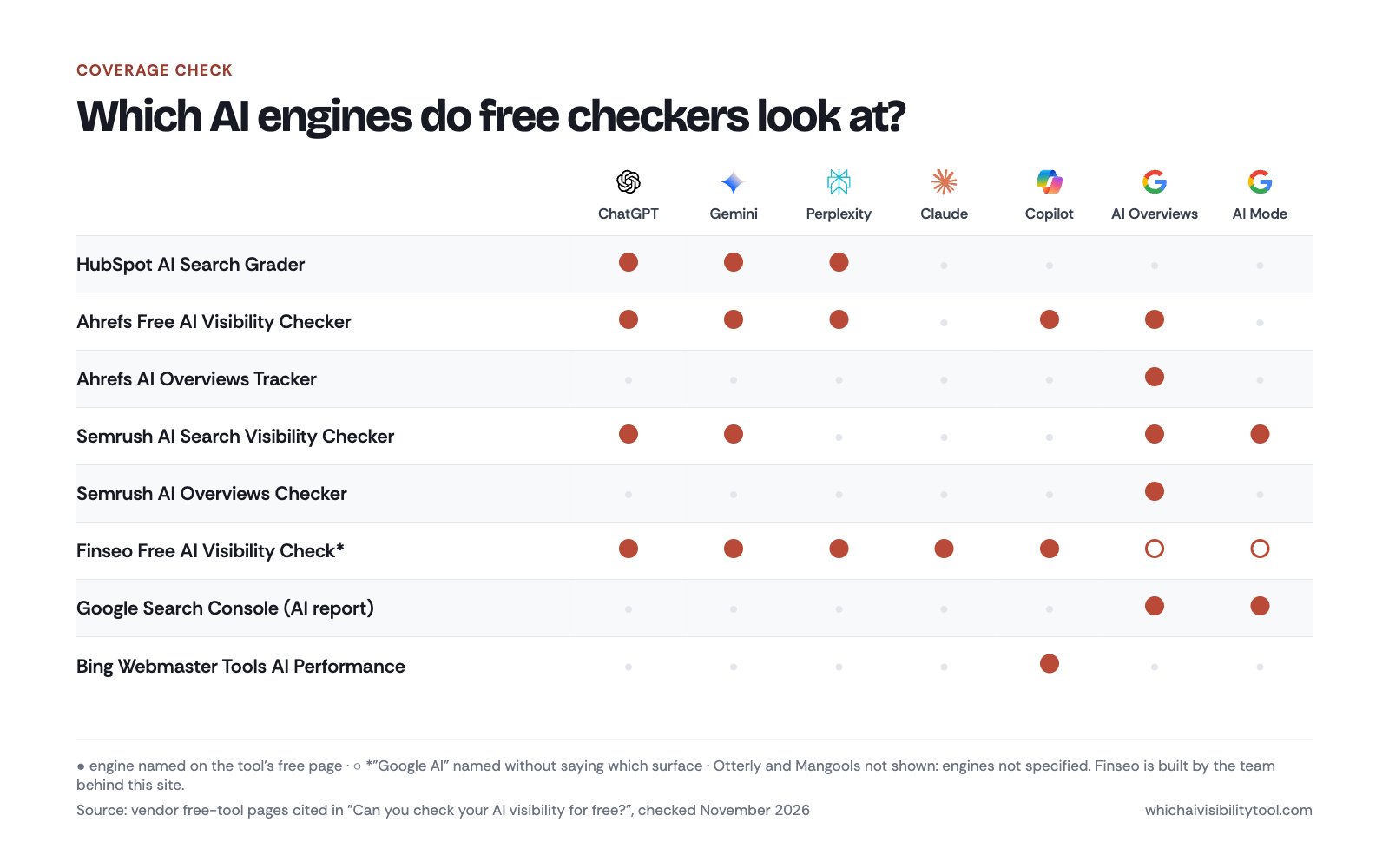
The following comparison focuses on what each free option publicly says it checks, rather than treating all “free” offers as equivalent. Some are one-time graders, some are limited previews, and some are audits or trials rather than permanent monitoring.[2]
| Tool | What it checks | Limits |
|---|---|---|
| HubSpot AI Search Grader | A one-time brand-perception analysis using ChatGPT, Perplexity and Gemini. It scores sentiment, presence quality, brand recognition, AI share of voice and market competition.[5] | It is a diagnostic rather than ongoing monitoring. HubSpot’s free page does not publish a repeat-check quota, and the results are not the same as a current web-citation tracker.[6][7] |
| Ahrefs Free AI Visibility Checker | Mentions across ChatGPT, Gemini, Perplexity, Copilot and Google AI Overviews, plus topics and cited domains or pages. Ahrefs says its prompts are based on real search behavior.[2] | The report is a limited preview showing the top five results in each section. Ahrefs does not publish a repeat-scan quota on the cited free-tool page.[6] |
| Ahrefs AI Overviews Tracker | A Google AI Overviews-focused view covering mentions over time, topics, cited domains and cited pages.[7] | It is narrower than a cross-engine checker and remains a limited preview. Full historical tracking is a separate product.[7] |
| Semrush AI Search Visibility Checker | An AI Visibility Score, mentions, cited pages, topics, prompts, competitor comparisons and estimated audience reach across ChatGPT, Gemini, Google AI Mode and AI Overviews.[3] | It allows three checks per day without registration. Audience reach is an estimate, not observed visits, and the score is not a universal visibility unit.[3] |
| Semrush AI Overviews Checker | Google AI Overviews visibility, queries, cited pages, competitor comparisons and query opportunities.[8] | It focuses on Google AI Overviews rather than the wider assistant ecosystem. Semrush says the score is relative, not an exact appearance count.[8] |
| Otterly free GEO tools | Brand-authority checks, AI-crawlability checks, content audits, prompt research and a GA4 template for AI referral visits.[9] | These resources answer different questions and do not demonstrate permanent free recurring brand monitoring. Requirements vary, and the platform’s free-trial limits are not published on the cited pages.[9] |
| Mangools AI Search Grader | An AI Search Score from 0 to 100, visibility, average ranking and competitor insights. Its visibility metric is based on the share of generated prompts where a brand appears in the Top 20.[5][10] | Without an account, access is restricted to a smaller model set. The cited pages do not publish the exact search quota or reset schedule, and the page’s model count and named-model list are inconsistent.[6] |
| Finseo Free AI Visibility Check | A scan across ChatGPT, Gemini, Claude, Perplexity, Google AI and Copilot that describes how AI presents a brand and whether it appears in reconstructed customer prompts.[11] | It is a quick scan, not daily monitoring. Although advertised as requiring no login, the form requests a website and email; the scan quota and repeat-use allowance are not published.[11] Finseo is built by the team behind this site. |
| Google Search Console generative-AI report | Site impressions and pages appearing in Google’s AI Overviews and AI Mode, with dimensions such as date, country and device.[3] | It measures Google Search exposure for a verified site, not whether ChatGPT, Claude or another assistant recommends the brand. It is an owner-side performance report rather than a universal brand-visibility score.[12] |
| Bing Webmaster Tools AI Performance | Pages used or cited in Copilot and partner AI answers, including grounding queries.[13] | It measures how Bing’s systems use a site’s content, not every brand recommendation across AI assistants. Bing notes that these metrics differ from traditional rankings, clicks and traffic.[13] |
The most useful first choice depends on the question:
- Choose Ahrefs for a broad, no-signup preview of mentions and cited sources.[7]
- Choose Semrush if three daily checks and a cross-platform comparison are useful.[3]
- Choose HubSpot for a one-time perception and sentiment baseline.[5]
- Choose Mangools when a generated-prompt score and Top-20 visibility definition are useful.[1][3]
- Choose Finseo for a quick scan that includes Claude and a reconstructed customer-prompt view.[11]
- Choose Search Console or Bing Webmaster Tools when the question is whether owned pages appear in Google or Copilot AI features.[13][3]
How should you compare free checker results?
1. Identify the unit being measured
A “mention” means the brand appears in an answer. A “citation” means a source associated with the answer points to the brand’s domain or page. A “presence” score may count either one, depending on the vendor’s definition.
Read the metric definition before comparing results. Mangools’ Top-20 visibility, Semrush’s relative score and HubSpot’s perception score are not interchangeable.[5]
2. Check which engines are included
Engine coverage changes the result. Ahrefs lists ChatGPT, Gemini, Perplexity, Copilot and Google AI Overviews for its free checker, while Semrush lists ChatGPT, Gemini, AI Mode and AI Overviews.[7][2]
Google AI Overviews and Google AI Mode are also not simply substitutes for standalone ChatGPT or Perplexity results. They can use different retrieval systems, interfaces and query contexts. A checker that covers one surface cannot represent the whole AI-search environment.[8][3]
3. Examine the prompt sample
A result depends on the prompts asked. A brand may appear for branded queries but disappear for category, comparison or problem-solving queries. A checker that generates prompts from search behavior may produce a different sample from one that asks models about a short brand description.[14][15] Finseo’s query fan-out study found that AI Mode rewrites one prompt into about nine synthetic searches, and 95% of them have zero search volume. That is one reason a prompt list built from keyword data may not mirror what an engine actually retrieves.
Ask whether the tool reveals:
- The actual prompts tested
- The number of prompts
- The countries and languages
- The date of the check
- Whether prompts are repeated
- Whether results include competitors
- Whether citations are visible
If those details are unavailable, treat the result as a snapshot rather than a complete audit.
4. Separate historical tracking from a preview
A free checker may expose a database preview without offering history. Ahrefs’ free checker shows a limited result set, while its separate Brand Radar product is positioned for broader monitoring.[3]
Historical data matters when the goal is to evaluate content changes, public relations activity or competitor movement. Without dated observations, a score cannot show whether visibility is improving or declining.
5. Treat “estimated reach” carefully
Some products estimate how many people may encounter a result. That is not the same as measuring visits, conversions or revenue. Semrush describes audience reach as an estimate, so it should not be reported as observed traffic.[3]
For downstream performance, use owner-side analytics such as Google Search Console or GA4. Search Console’s generative-AI report shows impressions for pages appearing in Google’s AI features, while a referral report can show visits that actually reached the site.[3]
Why can a single AI visibility check mislead you?
Why is one AI answer weak evidence?
AI answers can change between repeated runs of the same prompt. SparkToro’s repeated-run research found less than a one-in-100 chance that ChatGPT or Google’s AI would return the same brand list across two responses.[14]
That does not mean every result is random or useless. The research also found that some brands appeared repeatedly across many answers even when their exact rank changed. The practical lesson is to measure recurring presence, citations and context separately from one-off position.[3][12]
A single check can mislead for several reasons:
- Sampling: the prompt may not represent a real customer journey.
- Personalization: country, device, account history and custom settings can affect output.[16]
- Model differences: ChatGPT, Gemini, Perplexity and Google AI features do not necessarily use the same sources.
- Temporal change: web indexes, retrieval layers and model systems change over time.
- Ranking instability: a brand can appear frequently but move between first, third and tenth position.
- Citation ambiguity: a cited source may be relevant to only part of the generated answer.[3]
SparkToro’s study reported that repeated AI outputs often changed their brand lists and ordering, while some brands still had high presence rates across many responses.[14] This makes frequency of presence more informative than a single screenshot claiming “rank one.”
Two 2026 studies also support repeated sampling and uncertainty reporting. One found that citation-share confidence intervals of five to seven percentage points were common in one tested search system; another reported modest overlap between source sets and brand sets across repeated days.[17] These findings do not make measurement impossible, but they argue against presenting a small sample as a precise market-wide score.
How can you check AI visibility manually?
A manual audit is slower than a checker, but it makes the prompt and context visible. Use the same prompts, dates and recording format each time.
- Define the audience and market. Choose a country, language, product category and customer type before asking any questions.
- Create a fixed prompt set. Include branded, category, comparison, problem-solving and “best alternatives” prompts.
- Run each prompt in several engines. Use the assistants relevant to your market, and record the engine and interface.
- Repeat the prompts. Run them on multiple dates or repeat each prompt several times during the same audit.
- Record the full answer. Save whether the brand appears, its approximate position, the wording used, cited URLs, competitors and sentiment.
- Classify the result. Separate mention, recommendation, citation, positive or negative description, and product-level appearance.
- Check cited pages. Read the cited source and determine whether it supports the claim rather than assuming that citation equals accuracy.
- Compare owned-site evidence. Review Google Search Console for Google AI impressions and Bing Webmaster Tools for Copilot citations.[13][3]
- Report patterns, not isolated wins. State the number of prompts, engines, dates and repeated appearances.
- Repeat after changes. Run the same audit after publishing content, earning citations or updating important pages.
A useful spreadsheet might contain these columns:
| Date | Engine | Prompt | Brand mentioned? | Position | Cited URL | Competitors | Sentiment | Notes |
|---|
Do not combine all observations into one unexplained percentage. Report at least three separate measures:
- Presence rate: the percentage of tested answers mentioning the brand.
- Citation rate: the percentage citing the brand’s domain or pages.
- Position distribution: how often the brand appeared first, in the top three or later.
This approach cannot produce a universal market share. It does provide an auditable sample that another person can repeat.
What do free owner-side tools add?
Free or included owner-side tools answer a narrower but valuable question: whether a site’s pages are being exposed in particular AI search systems.
Google Search Console’s generative-AI report includes impressions from AI Overviews and AI Mode, pages appearing in those features, and dimensions such as date, country and device.[3][18] It is useful for identifying pages that receive visibility in Google’s own generative-search surfaces.
Bing Webmaster Tools’ AI Performance report shows site pages used or cited in Copilot and partner AI answers, along with grounding queries.[13] Bing explicitly distinguishes these metrics from traditional rankings, clicks and traffic.[13]
GA4-based referral analysis answers a downstream question: whether people arrived at the site from AI assistants. Otterly’s free GA4 resource is designed to identify AI referral visits and landing pages.[9] Referral data cannot count mentions that produced no click, so it complements rather than replaces prompt and citation checks.[3] Finseo’s review of six studies on AI search attribution suggests that analytics records only about 1 in 10 AI-driven conversions, so referral counts are best read as a lower bound.
Use these tools together:
- Prompt checkers show what assistants say.
- Citation analysis shows which sources they use.
- Search Console and Bing show owned-page exposure in specific ecosystems.
- Analytics shows visits that reached the site.
- Conversions and CRM data show whether those visits generated business outcomes.
When should you upgrade from a free checker?
Stay with free tools when you are:
- Exploring whether a brand is recognized at all
- Building a first prompt list
- Checking a small number of competitors
- Looking for obvious citation or content gaps
- Validating whether an owned site appears in Google or Copilot features
- Learning which engines matter before committing to a monitoring process
Upgrade when the decision requires:
- Historical visibility trends
- Repeated custom prompts
- Multiple countries or languages
- Competitor tracking over time
- Citation inventories and source changes
- Alerts or recurring reports
- Prompt-level recommendations
- Integration with analytics, workflows or project-management systems
The difference is not simply “more features.” It is a change from inspection to measurement. HubSpot’s free grader is described as a one-time check, Ahrefs’ checker is a limited preview, and Semrush offers three free checks per day without registration.[3] Those are useful entry points, but they do not provide the same evidence as a dated time series built from a stable prompt set.
Paid examples illustrate the upgrade path without making the products equivalent: HubSpot lists its standalone AEO product at $50 per month, while Ahrefs lists Brand Radar from $199 per month for selected platforms.[2] Pricing and included coverage can change, so verify the vendor page before purchasing.
The right upgrade trigger is therefore operational. If a one-off result changes a content decision, repeat it first. If repeated checks become part of monthly reporting, competitor analysis or revenue attribution, a monitoring platform may save enough manual work to justify its cost.
Frequently asked questions
What is the best free AI visibility checker?
There is no universal best option because the tools measure different things. Ahrefs offers a broad no-signup preview of mentions and citations, Semrush allows three daily checks across four listed surfaces, HubSpot focuses on one-time brand perception, and Mangools reports a Top-20 prompt-visibility measure.[2]
Can I check whether my brand appears in ChatGPT for free?
Yes. Free checkers such as Ahrefs, Semrush, HubSpot, Mangools and Finseo publish options that include ChatGPT or related AI-search checks.[3] You can also enter the same customer-style prompt manually in ChatGPT, but one answer is not proof of stable visibility because repeated outputs can differ.[3][15]
Are free AI visibility scores accurate?
They can be useful directional indicators, but scores are not standardized. Semrush describes its score as relative, Mangools defines visibility using Top-20 prompt appearances, and HubSpot combines several perception dimensions into a composite score.[5] Compare results only after checking the engines, prompts, date and metric definition.
Do free AI visibility checkers track citations?
Some do. Ahrefs reports cited domains and pages, Semrush reports cited pages, and Finseo’s free-check description includes AI visibility results across named surfaces.[2][3] A citation still needs to be checked for support because citation presence does not guarantee that the source supports the generated claim.[3]
How often should I check AI visibility?
Run a small manual baseline at least twice before drawing a conclusion, then choose a cadence based on how quickly the market and content change. A recurring monthly or weekly process is more useful than repeatedly checking one prompt once, because AI recommendations can vary substantially between runs.[12][14]
Can Google Search Console measure my ChatGPT visibility?
No. Google Search Console’s generative-AI report measures site impressions and pages in Google Search AI features such as AI Overviews and AI Mode.[18][3] It does not measure all brand recommendations or citations in ChatGPT, Claude, Perplexity or other standalone assistants.
Sources
- 1AI Visibility Checker – Track Citations in ChatGPT & More otterly.ai
- 2Free AI Visibility Checker by Ahrefs: Track Your Brand in AI search ahrefs.com
- 3Free AI Visibility Tool: Check Brand Visibility in AI Search semrush.com
- 4Evaluating Verifiability in Generative Search Engines - ACL Anthology aclanthology.org
- 5AI Search Grader: Free One-Time AEO Brand Check, No Account Required hubspot.com
- 6What can I use for free in Ahrefs? | Help Center - Ahrefs help.ahrefs.com
- 7Free AI Overviews Tracker by Ahrefs: Track Your Brand in AI Overviews ahrefs.com
- 8AI Overviews Checker: Track Your Visibility in Google's AIOs semrush.com
- 9Free GEO Tools & Resources | OtterlyAI otterly.ai
- 10AI Search Grader: Free Answer Engine Optimization Tool mangools.com
- 11Free AI Visibility Check, Book Your Analysis Call | Finseo finseo.ai
- 12Don’t Measure Once: Measuring Visibility in AI Search (GEO) arxiv.org
- 13AI Performance - Bing Webmaster Tools bing.com
- 14NEW Research: AIs are highly inconsistent when recommending brands or products; marketers should take care when tracking AI visibility - SparkToro sparktoro.com
- 15From Stochastic to Stable Rank Stability and Structural Sufficiency in AI Visibility Measurement arxiv.org
- 16Characterizing Web Search in the Age of Generative AI aclanthology.org
- 17Quantifying Uncertainty in AI Visibility A Statistical Framework for Generative Search Measurement arxiv.org
- 18Generative AI performance report (Search) - Search Console Help support.google.com